
When learning steel guitar we often face the question about choosing one guitar tuning.
We keep wondering what is the best tuning. And there are much information out there convincing us what is the best for what. One of the beauties of playing steel guitar is the inmense variety available for the instrument. Specially if we are able to handle different tunings. And doing so is very easy.
So you should not think I will work in this tuning and maybe in a few years I will be able to take a new one. Understanding tunings allow you to instantly move from one to another as needed. Think of tunings as a capo that you put on and off or move up and down the neck as you need it.
Although I explained them in depth in other publications I will mention a few points here as reminders.
GUITAR STRINGS RELATIONS
The guitar strings create relations by the way you tune them. For instance, in a G low bass tuning the first three strings are related in one side, the sixth and fifth would be on another while the fourth string varies accordingly. This same thing would happen in an E tuning but having instead the first four strings versus the sixth and fifth.
These relations are based on functions. The first three strings on a G low bass tuning are multifunctional. They cover melodic playing, harmonizing melodies, extremely developed chord voicing as well as other more particular functions. The sixth and fifth strings on the same tuning have functions like playing bass lines, doubling, enriching harmonies, etc.
For these groups of strings to have these functions they need to meet certain requirements. The physical proximity, their intervalic relation and even their gauge influence the final functional decisions. These strings relations and functions are shared along the different tunings.
Sometimes it is presented in a straight manner. Like when shifting from G low bass to G high bass tuning. Other times they are translated. This makes it a little more difficult to be recognized. Like going from G low bass to D tuning. In other easier cases we just have the same tuning transposed one step up or down. Like when moving between E and D tuning or G low bass and A low bass (Spanish) tuning.
Other times it is still the same tuning with a slight variation due to stylistic reasons. Like using a G or a G6th tuning. Or and E or Em tuning.
So if you are able to recognize these strings relations and functions you will easily switch from one tuning to another without having to relearn things.
Let’s take a look to a simple chart so you can picture this.
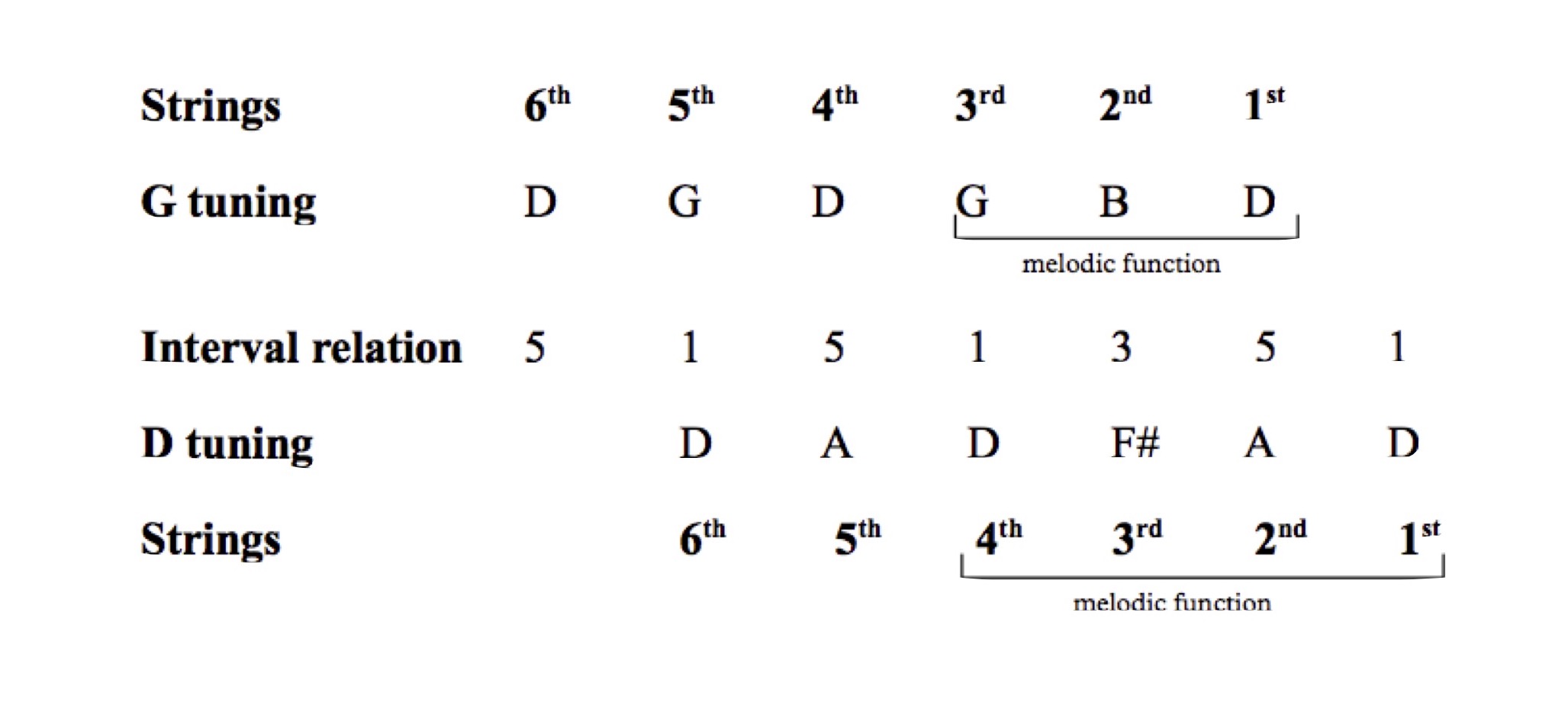
In the following chart we have two very common tunings. G low bass and D.
First you will see the strings number for the G tuning. This is followed by the notes.
You will notice here that on the G low bass tuning our melodic functions are mainly covered by the first three strings. If you look underneath you will see the interval relationship. This is what interval is every note for the key of the tuning. In the G tuning we have the fifth, root, fifth, root, major third and fifth.
Notice now how the strings having a melodic function have a relation of root, third and fifth. Just in that specific order. If you continue looking, bellow it you will find the notes of the D tuning. Right on top of them and sharing with the G tuning is the intervalic relationship. On the bottom are the strings of the D tuning.
Notice now how the melodic functions in the D tuning are covered by the first four strings. In reality the fourth, third and second strings are the same as in the G tuning but in a different key. That is why the interval relation is exactly the same. Root, third and fifth.
What happens in the D tuning is that we added another string on top (while we took off one from the bottom). This new string on top has a high pitch so we are extending the melodic range. Hence the melodic function strings are also extended from three to four.
In reality from the fifth string to the first on the G tuning and from the sixth to the second on the D tuning we have exactly the same intervalic relationship. So everything we learnt in one or the other can be used in both.
Every time you look into using a different or new tuning take some time to examine it.
Write down the intervalic relationship of its notes. Recognize patterns also available in tunings you usually work with. The moment you become aware of all these things you will realize that the change is effortless. And except for certain peculiarities that every tuning has, you already know most of it.
This article comes from “Advanced Steel Guitar Method, Vol. I by Fernando Perez”.